


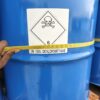
methylene chloride
Methylene chloride (also called dichloromethane, DCM) is a volatile, colorless, sweet-smelling organic solvent widely used in industry.
Basic Facts
Chemical formula: CH₂Cl₂
Appearance: Colorless liquid
Common uses:
Paint strippers
Adhesive removers
Pharmaceutical and chemical processing
Degreasing
Extraction in labs and manufacturing
Safety & Health
Methylene chloride is toxic and potentially lethal at high exposure:
Converts to carbon monoxide in the body → can reduce oxygen delivery.
Can cause dizziness, headaches, unconsciousness, and in severe cases death.
Classified as a potential carcinogen.
Vapors are heavier than air and can accumulate in low areas.
Regulation
In many countries (including the U.S.), consumer use of methylene-chloride paint strippers has been banned due to fatalities. Industrial use is still allowed under strict controls.
Handling (high-level safety only)
Use only in well-ventilated areas or under engineered ventilation.
Proper PPE: chemical-resistant gloves, goggles, and protective clothing.
Avoid inhalation and skin contact.
₦370,000.00
Description
Methylene chloride (also called dichloromethane, DCM) is a volatile, colorless, sweet-smelling organic solvent widely used in industry.
Basic Facts
Chemical formula: CH₂Cl₂
Appearance: Colorless liquid
Common uses:
Paint strippers
Adhesive removers
Pharmaceutical and chemical processing
Degreasing
Extraction in labs and manufacturing
Safety & Health
Methylene chloride is toxic and potentially lethal at high exposure:
Converts to carbon monoxide in the body → can reduce oxygen delivery.
Can cause dizziness, headaches, unconsciousness, and in severe cases death.
Classified as a potential carcinogen.
Vapors are heavier than air and can accumulate in low areas.
Regulation
In many countries (including the U.S.), consumer use of methylene-chloride paint strippers has been banned due to fatalities. Industrial use is still allowed under strict controls.
Handling (high-level safety only)
Use only in well-ventilated areas or under engineered ventilation.
Proper PPE: chemical-resistant gloves, goggles, and protective clothing.
Avoid inhalation and skin contact.
Regulatory Status of Methylene Chloride
United States
EPA (Toxic Substances Control Act, TSCA) – Latest Risk Management Rule
In April 2024, the U.S. EPA finalized a risk management rule under TSCA that bans most uses of methylene chloride.
US EPA
+2
US EPA
+2
All consumer uses are prohibited.
US EPA
+2
US EPA
+2
Most industrial/commercial uses will be phased out: according to the rule:
Prohibition of industrial/commercial use after April 28, 2026 for many uses.
SGSCorp
+1
There are limited exemptions (13 “critical” uses) under a strict “Workplace Chemical Protection Program” (WCPP).
Occupational Health & Safety
+1
The EPA established much stricter inhalation limits (“Existing Chemical Exposure Limit,” ECEL):
2 ppm (8-hour TWA)
16 ppm (15-minute)
Office of Research Services
+1
There’s a requirement for periodic exposure monitoring under the WCPP.
US EPA
OSHA Standards
The U.S. Occupational Safety and Health Administration (OSHA) has a specific standard for methylene chloride: 29 CFR 1910.1052.
osha.gov
Under this standard, the old PELs are:
8-hour TWA: 25 ppm
osha.gov
15-minute Short-Term Exposure Limit (STEL): 125 ppm
osha.gov
+1
Employers must monitor exposure, provide medical surveillance, etc.
osha.gov
+1
Risk Determination
In November 2022, EPA published a final revised risk determination under TSCA finding that methylene chloride “presents an unreasonable risk of injury to human health” in 52 of 53 evaluated “conditions of use.”
US EPA
+1
This drove the risk-management (“phase-out + controls”) rule that was finalized in 2024.
US EPA
+1
European Union (EU)
REACH – Restriction (Annex XVII)
Methylene chloride (CAS 75-09-2) is restricted under REACH Annex XVII.
European Chemicals Agency
+1
Specifically, its use in paint strippers for general public (“consumer”) is limited: many products containing ≥ 0.1% are restricted.
Farnell
There are also industrial/professional restrictions: certain conditions of use are regulated.
Rapid Online
+1
Occupational Exposure Limits (EU)
Under Directive 2000/39/EC, there are indicative occupational exposure limit values (OELs) for certain chemicals, though this is a “first list.”
EU-OSHA
More broadly, Directive 98/24/EC (Chemical Agents Directive) requires employers to assess risks, put measures in place, etc., for workers exposed to chemical agents.
EU-OSHA
ECHA (European Chemicals Agency) maintains OEL work, particularly for carcinogens and other very hazardous substances.
European Chemicals Agency
Classification & Labeling
Under the EU CLP (Classification, Labelling, Packaging) regime, methylene chloride is classified as hazardous. For example, its SDS shows Carcinogenic classification.
sds.edqm.eu
Key Implications & Trends
There is a global trend toward restricting methylene chloride, mainly because of its health risks (e.g., cancer, neurotoxicity).
Even where full bans are not implemented, regulators are pushing for tight exposure limits, more monitoring, and safe-work programs.
Some “critical” uses are being preserved under strict control, especially in industrial or research settings — but “non-critical” uses are being phased out.
Related products
- Sale!
- Technical Chemical Raw Materials, Water Treatment Chemicals
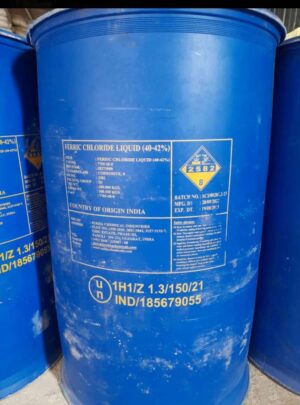
Ferric Chloride
- Original price was: ₦270,000.00.₦250,000.00Current price is: ₦250,000.00.
- Add to cart
- Sale!
- Technical Chemical Raw Materials
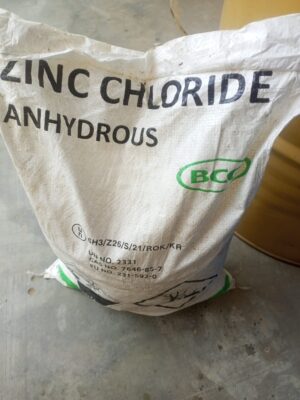
Zinc Chloride Anhydrous
- Original price was: ₦143,000.00.₦142,500.00Current price is: ₦142,500.00.
- Add to cart
Reviews
There are no reviews yet.