


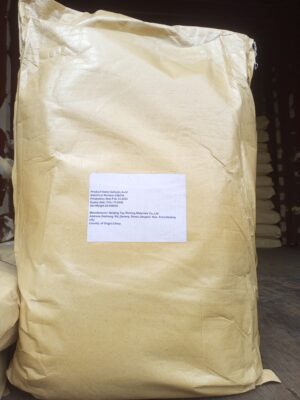
Labsa sulphonic acid
LABSA stands for Linear Alkyl Benzene Sulphonic Acid. It is a key raw material in the production of detergents and surfactants.
2. Chemical Nature:
It is a sulfonic acid derivative of linear alkylbenzene (LAB).
The general chemical formula can be represented as:
𝐶
6
𝐻
5
−
(
𝐶
𝑛
𝐻
2
𝑛
+
1
)
−
𝑆
𝑂
3
𝐻
C
6
H
5
−(C
n
H
2n+1
)−SO
3
H
where
𝑛
n usually ranges from 10 to 16.
3. Properties:
Physical: Usually a yellowish to brown oily liquid, viscous.
Acidic: Strong sulfonic acid character.
Solubility: Slightly soluble in water, but forms strong surfactants when neutralized (like with NaOH).
4. Uses:
Main raw material for anionic detergents.
Used in household detergents, dishwashing liquids, shampoos, and industrial cleaners.
Can be neutralized with sodium hydroxide (NaOH) to produce sodium linear alkylbenzene sulfonate (Na-LAS), a common detergent.
5. Safety Considerations:
Strongly acidic, can cause burns.
Corrosive to metals in concentrated form.
Requires proper handling and storage.
₦670,000.00
Description
LABSA stands for Linear Alkyl Benzene Sulphonic Acid. It is a key raw material in the production of detergents and surfactants.
2. Chemical Nature:
It is a sulfonic acid derivative of linear alkylbenzene (LAB).
The general chemical formula can be represented as:
𝐶
6
𝐻
5
−
(
𝐶
𝑛
𝐻
2
𝑛
+
1
)
−
𝑆
𝑂
3
𝐻
C
6
H
5
−(C
n
H
2n+1
)−SO
3
H
where
𝑛
n usually ranges from 10 to 16.
3. Properties:
Physical: Usually a yellowish to brown oily liquid, viscous.
Acidic: Strong sulfonic acid character.
Solubility: Slightly soluble in water, but forms strong surfactants when neutralized (like with NaOH).
4. Uses:
Main raw material for anionic detergents.
Used in household detergents, dishwashing liquids, shampoos, and industrial cleaners.
Can be neutralized with sodium hydroxide (NaOH) to produce sodium linear alkylbenzene sulfonate (Na-LAS), a common detergent.
5. Safety Considerations:
Strongly acidic, can cause burns.
Corrosive to metals in concentrated form.
Requires proper handling and storage.
1. Raw Materials
The main raw materials for LABSA production are:
Linear Alkyl Benzene (LAB) – C10–C16 alkyl chain attached to benzene, usually produced by alkylation of benzene with linear olefins.
Sulfuric acid (H₂SO₄) or oleum (H₂SO₄ + SO₃) – used for sulfonation.
2. Production Process
The process is mainly sulfonation of LAB to form LABSA. There are two main industrial methods:
A. Concentrated Sulfuric Acid Method
LAB is mixed with concentrated H₂SO₄ (≈98%).
The mixture is stirred at a controlled temperature (usually 50–70°C) to allow sulfonation.
The reaction produces LABSA directly:
𝐶
6
𝐻
5
–
𝐶
𝑛
𝐻
2
𝑛
+
1
+
𝐻
2
𝑆
𝑂
4
⟶
𝐶
6
𝐻
5
–
𝐶
𝑛
𝐻
2
𝑛
+
1
–
𝑆
𝑂
3
𝐻
C
6
H
5
–C
n
H
2n+1
+H
2
SO
4
⟶C
6
H
5
–C
n
H
2n+1
–SO
3
H
Advantages: Simple, low cost.
Disadvantages: Corrosive acid handling, produces acidic by-products.
B. Oleum Method (Most Common Industrially)
LAB is treated with oleum (H₂SO₄ containing SO₃) in a reactor.
The reaction is highly exothermic, so temperature control is crucial.
The reaction forms LABSA with fewer side-products than the concentrated acid method.
Reaction:
𝐶
6
𝐻
5
–
𝐶
𝑛
𝐻
2
𝑛
+
1
+
𝑆
𝑂
3
→
oleum
𝐶
6
𝐻
5
–
𝐶
𝑛
𝐻
2
𝑛
+
1
–
𝑆
𝑂
3
𝐻
C
6
H
5
–C
n
H
2n+1
+SO
3
oleum
C
6
H
5
–C
n
H
2n+1
–SO
3
H
Advantages:
Higher conversion efficiency
Better product quality (less discoloration)
3. Neutralization (Optional)
After sulfonation, LABSA can be neutralized with alkalis like NaOH or KOH to produce anionic detergents:
𝐶
6
𝐻
5
–
𝐶
𝑛
𝐻
2
𝑛
+
1
–
𝑆
𝑂
3
𝐻
+
𝑁
𝑎
𝑂
𝐻
→
𝐶
6
𝐻
5
–
𝐶
𝑛
𝐻
2
𝑛
+
1
–
𝑆
𝑂
3
𝑁
𝑎
+
𝐻
2
𝑂
C
6
H
5
–C
n
H
2n+1
–SO
3
H+NaOH→C
6
H
5
–C
n
H
2n+1
–SO
3
Na+H
2
O
This produces sodium linear alkylbenzene sulfonate (Na-LAS), widely used in detergents.
4. Industrial Considerations
Temperature and mixing: Crucial to avoid side reactions and decomposition.
Corrosion: Sulfonation reactors are made of special alloys (like stainless steel with acid-resistant lining).
Purity: High LAB purity gives better product quality.
By-products: Minimal, mostly residual sulfuric acid which can be recycled.
✅ Summary:
LABSA is made by sulfonating linear alkylbenzene with concentrated H₂SO₄ or oleum. The oleum method is preferred industrially due to better product quality and efficiency. Neutralization produces a detergent-ready product.
Related products
- Sale!
- Technical Chemical Raw Materials
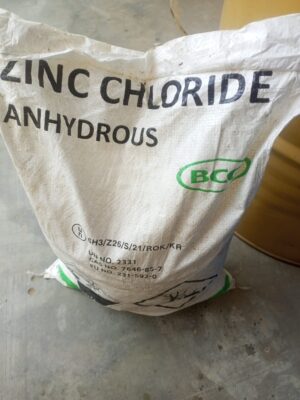
Zinc Chloride Anhydrous
- Original price was: ₦143,000.00.₦142,500.00Current price is: ₦142,500.00.
- Add to cart
Reviews
There are no reviews yet.