

citric acid monohydrate
Citric Acid Monohydrate – Short Notes
Chemical Name: Citric acid monohydrate
Formula: C₆H₈O₇·H₂O
Molecular Weight: ~210.14 g/mol
Nature: Weak organic tricarboxylic acid
Structure & Acidity
Contains three –COOH groups and one –OH group
Triprotic acid (donates 3 H⁺ ions)
pKa values: ~3.1, 4.8, 6.4
Monohydrate = one molecule of water of crystallization
Physical Properties
White, crystalline, odorless powder
Sour taste
Highly soluble in water
Melting point: ~135 °C (decomposes)
Chemical Properties
Acts as:
Chelating agent (binds Ca²⁺, Fe³⁺)
Buffering agent
Acidulant
Forms citrate and hydrogen citrate ions in solution
Preparation
Produced by fermentation of sugars using Aspergillus niger
Crystallized from aqueous solution as monohydrate
Uses
Food industry: Preservative, acidulant (E330)
Pharmaceuticals: Excipient, effervescent tablets
Laboratory: Buffer preparation, reagent
Industrial: Cleaning and descaling agent
Safety
Generally safe (GRAS)
May cause mild skin and eye irritation
Store in cool, dry conditions
Difference from Anhydrous Citric Acid
Monohydrate contains one water molecule
More stable than anhydrous form
One-Line Summary (Very Important)
Citric acid monohydrate is a weak organic tricarboxylic acid containing one molecule of water of crystallization, widely used as an acidulant, buffer, and chelating agent.
₦36,000.00
Description
Citric Acid Monohydrate
Chemical Formula: C₆H₈O₇·H₂O
Molar Mass: ~210.14 g/mol
CAS Number: 5949-29-1
Chemical Class: Organic acid (tricarboxylic acid)
Citric acid monohydrate is citric acid that contains one molecule of water of crystallization per molecule of citric acid.
2. Structure and Composition
Citric acid itself has:
Three carboxyl groups (–COOH)
One hydroxyl group (–OH)
It is a triprotic acid, meaning it can donate three hydrogen ions (H⁺) in solution.
The “monohydrate” part does not mean one acidic hydrogen; it means one water molecule is physically bound in the crystal lattice.
3. Physical Properties
Appearance: White or colorless crystalline powder or granules
Odor: Odorless
Taste: Strongly acidic (sour)
Solubility: Very soluble in water; soluble in ethanol
Melting Point: ~135 °C (decomposes)
Density: ~1.54 g/cm³
4. Chemical Properties
Acidity (pKa values):
pKa₁ ≈ 3.1
pKa₂ ≈ 4.8
pKa₃ ≈ 6.4
Acts as:
Chelating agent (binds metal ions like Ca²⁺, Fe³⁺)
Buffering agent
Acidulant
In aqueous solution, citric acid can exist as:
Citric acid (H₃Cit)
Dihydrogen citrate (H₂Cit⁻)
Monohydrogen citrate (HCit²⁻)
Citrate ion (Cit³⁻)
5. Production
Produced industrially by fermentation of sugars (glucose or sucrose) using Aspergillus niger.
The monohydrate form crystallizes naturally from aqueous solutions at room temperature.
6. Uses and Applications
Food Industry
Food additive E330
Flavor enhancer and preservative
Controls pH in beverages, candies, jams, and dairy products
Pharmaceutical & Medical
Excipient in tablets and syrups
Used in effervescent formulations
Prevents kidney stone formation (citrate therapy)
Laboratory & Chemical Industry
Buffer preparation
Chelating agent
Cleaning and descaling agent
Analytical chemistry reagent
Cosmetics & Personal Care
pH adjuster
Exfoliating agent (AHA)
7. Safety and Handling
Generally Recognized as Safe (GRAS)
Mildly irritating to eyes and skin in concentrated form
Inhalation of dust may cause respiratory irritation
Store in a cool, dry place in a tightly closed container
8. Difference Between Citric Acid Monohydrate and Anhydrous Citric Acid
Feature Monohydrate Anhydrous
Water content Contains 1 H₂O No water
Molecular weight Higher Lower
Stability More stable More hygroscopic
Common use Food & pharma Labs & dry formulations
9. Summary
Citric acid monohydrate is a widely used organic acid containing one molecule of water, known for its acidic, buffering, and chelating properties, and is essential in food, pharmaceutical, cosmetic, and industrial applications.
Related products
- Sale!
- Food Chemicals Products
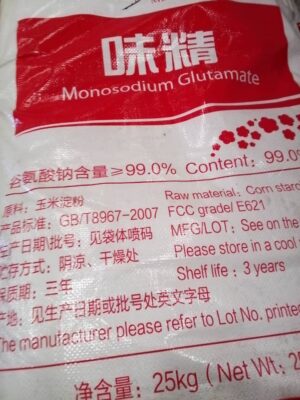
Monosodium Glutamate MSG
- Original price was: ₦50,000.00.₦45,000.00Current price is: ₦45,000.00.
- Add to cart
Reviews
There are no reviews yet.